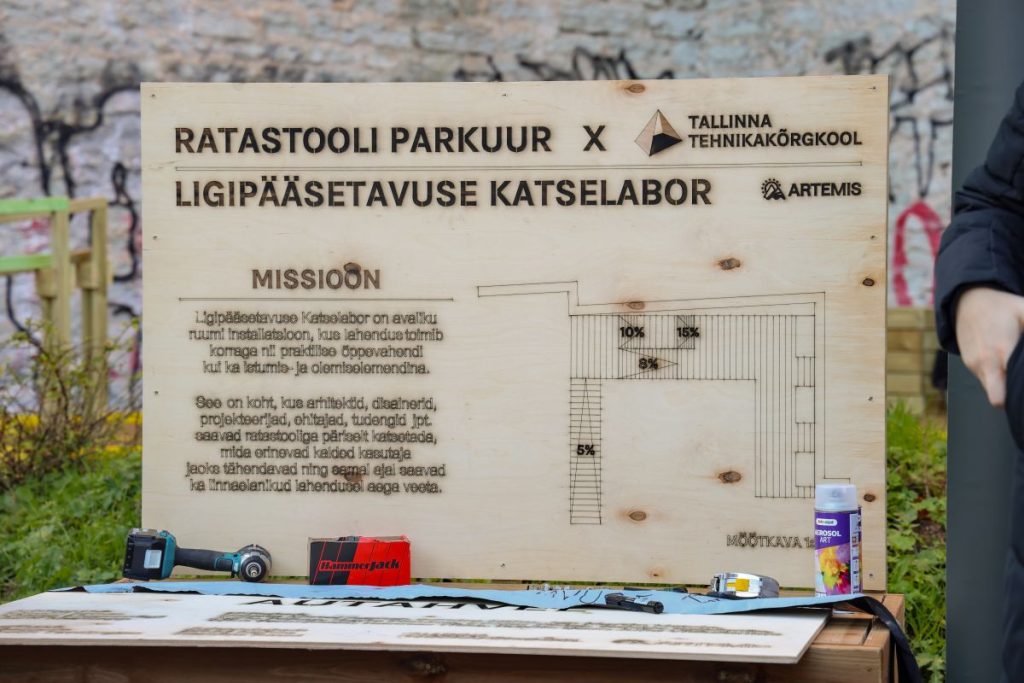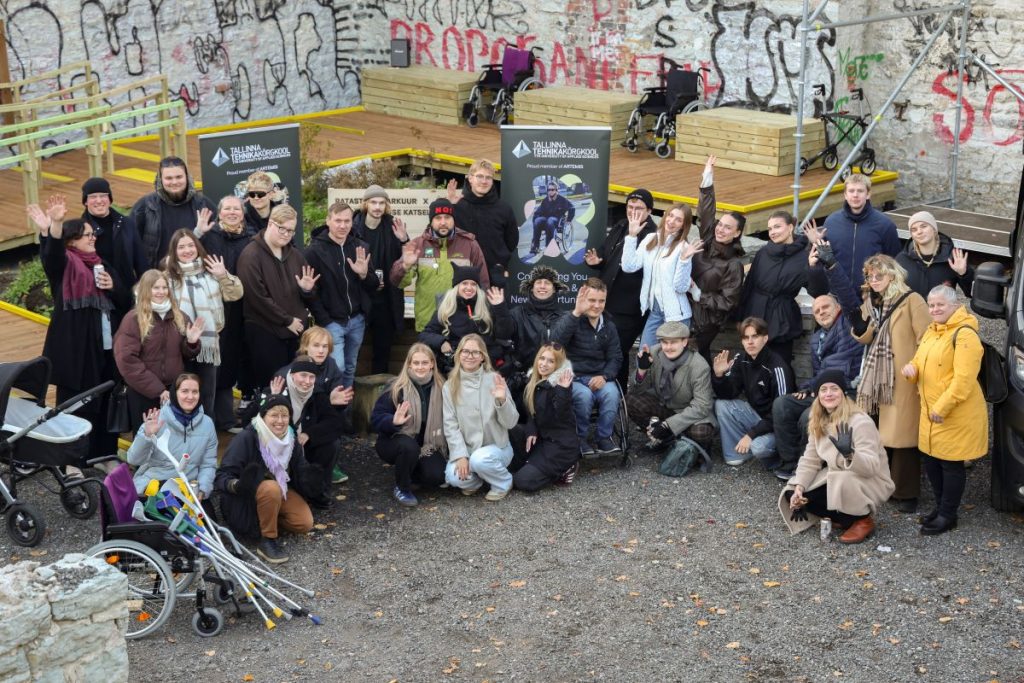


TTK University of Applied Sciences students and lecturers have joined forces to establish an accessibility testing laboratory at Kotzebue 2 in Tallinn. The laboratory allows visitors to experience ramps with different gradients first-hand, helping them better understand the importance of accessible public spaces through practical experience.
On paper, all ramps may seem alike. In reality, however, there is a significant difference between a ramp with a gradient of 5%, 8%, 10% or 15%. The testing laboratory, located in the Kalamaja district, allows visitors to experience these differences for themselves. The idea emerged during discussions held as part of a community work event.
“We wanted to create a place in Tallinn where people could actually try out ramps with different gradients. Kotzebue 2 was an ideal location, as it is frequented by architects, creative professionals and other users of urban space,” explain the project leads, guest lecturers at the Institute of Architecture, Erkki Koitla and Hendra Raud.
Ramps as an Accessible Solution and Part of Public Space
The aim of the testing laboratory is to raise awareness of accessibility and demonstrate how spatial design solutions affect people’s ability to move around in public spaces.
A ramp does not have to be merely a technical solution or a mandatory addition to a building or urban environment. When thoughtfully designed, it can also provide opportunities for resting, sitting and playing.
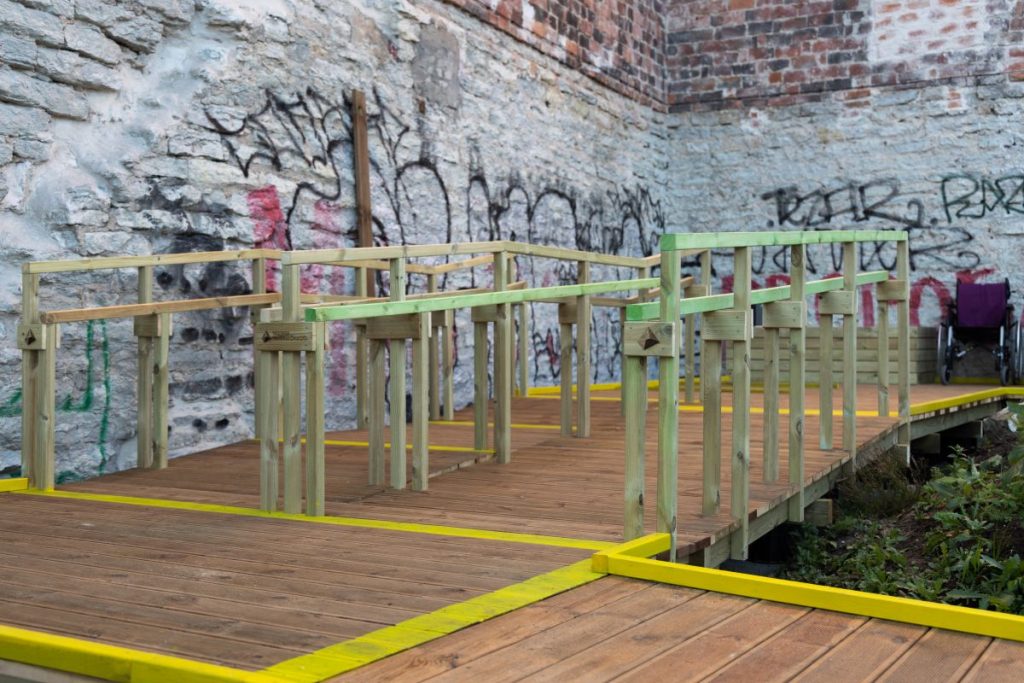
At the testing laboratory, visitors can try out ramps with different gradients and experience how changes in slope affect their usability. The structures can be used for wheelchair access, as well as for sitting and playing.
From Three Student Teams’ Ideas to a Completed Structure
The final design of the testing laboratory was selected through an architectural competition. As part of the Accessible Space course, three student teams developed different design proposals, from which the most suitable solution was selected with the help of experts. The chosen design was then brought to life together with the students.
Students from TTK’s Architecture, Building Construction and Facilities Management programmes collaborated on the design and implementation of the project. Architecture students were responsible for developing the spatial design, construction students helped address structural and construction-related challenges, while facilities management students contributed to the joint building process.
One of the main technical challenges was ensuring the durability of the wooden ramp in outdoor conditions. Careful consideration had to be given to structural strength, material durability and the design of the handrails. During construction, students worked together to resolve emerging challenges, demonstrating close cooperation across different fields of study.
The project leads were extremely pleased with the collaboration.
“The most rewarding part was seeing how well the students worked together and how much enthusiasm and care they put into the project. As lecturers, we feel truly privileged to work with students like these. The project would not have been completed without them, and we are sincerely grateful to everyone involved.”
The accessibility testing laboratory was developed as part of a co-creation session within the international ARTEMIS project, bringing together different stakeholders to jointly explore ways of creating more accessible and inclusive urban spaces.
Architects: Romili Ernes, Anette Klaasmägi and Merit Merilepp.
Builders: Helena Mirtel Aamer, Sandra Kahu, Jan Martin Metsla, Agris Pehap, Gayle Punane, Kuldar Põder, Sander Roosimäe, Siim Tennosaar, Hannes Tiido, Eveliis Usar and Julia Vitšužanina.
We would like to thank all the students and project partners who helped turn an idea into a practical, real-world solution!
The following experts contributed to the project:
- Villu Urban, Accessibility Expert
- Käthriin Lilp, Consumer Protection and Technical Regulatory Authority
- Arabella Aabrams, Curator of K2, Estonian Academy of Arts
- Niidy Maalinn, TTK University of Applied Sciences
- Kaur Talpsep, TTK University of Applied Sciences
- Erkki Koitla, TTK University of Applied Sciences
- Hendra Raud, TTK University of Applied Sciences
- Jako Stein, Tallinn Social Welfare and Health Care Department
- Ivika Puust, Tallinn Urban Planning Department
- Johan Kirsimäe, Estonian Academy of Arts
Photos: Ryan James Raud Mickle